
Training

Home / ORC Training Programme
ORC-TRG-001 Modules 1–6 · ORS-Approved · L. Sandhu: Confirmed

ORC Training

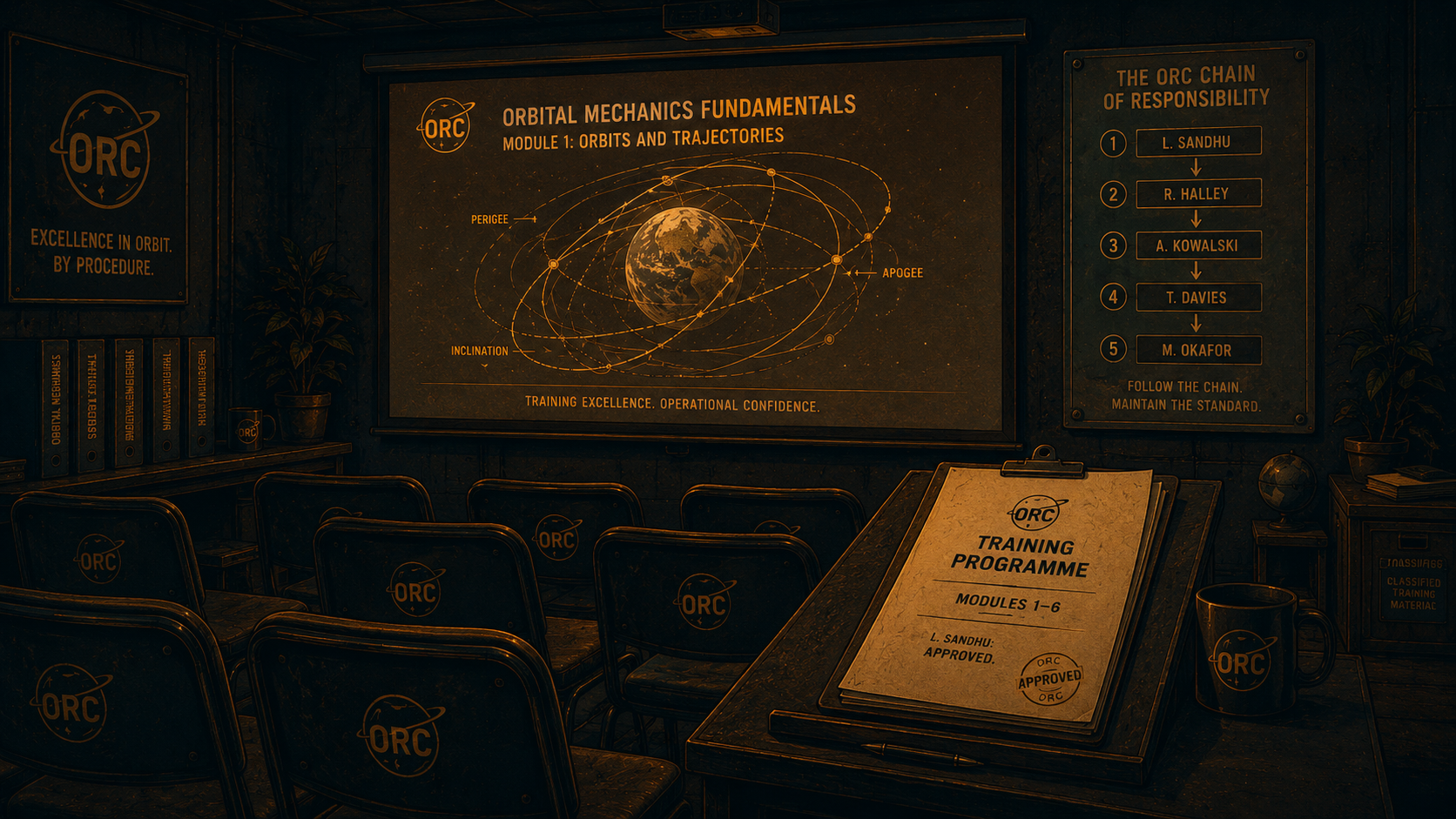
Complete all six modules to prepare for operational deployment. Certificates are issued on completion. Certificates are not contracts of employment. L. Sandhu has confirmed this. L. Sandhu has confirmed it more than once. Module 7 is the game.
ORC Training
ORC TRAINING PROGRAMME · 6 MODULES
OVERSEEN BY L. SANDHU · ORS-APPROVED
PROGRAMME

About the training programme

The ORC Training Programme was established in 2016 following an ORS audit that noted several gaps in formal operational procedure documentation. L. Sandhu wrote most of it. M. Hargreaves authorised all of it. C. Morrison has read all of it. This is more than can be said for some current staff, who L. Sandhu is not naming.

01
REGULATORY
ORS framework, approach corridors, approval chains, and regulatory interruptions. Prepared by L. Sandhu. L. Sandhu has a laminated diagram. It is available on request.
MANDATORY
02
OCELOT
OCELOT systems operation. Theoretical only. OCELOT has been offline since August 2023. T. Davies has prepared supplementary notes. They are attached. They are also theoretical.
MANDATORY OCELOT OFFLINE
03
FUEL MANAGEMENT
Fuel allocation and petty cash procedures. P. Patel contributed the orbital mechanics. Finance contributed the concerns. Finance has many concerns.
PRACTICAL
04
APPROVAL CHAIN
Sequential approval procedures. Five signatories. One laminated diagram. This module involves clicking people in the correct order. L. Sandhu found this pedagogically appropriate.
PRACTICAL
05
CLASSIFICATION
Debris classification using Dr. Chen’s model. Dr. Chen contributed to this module. Dr. Chen’s model has been correct on 1,848 occasions and incorrect on none. This is also Dr. Chen’s count.
PRACTICAL
06
REPORTING
Mission report writing. C. Morrison prepared this module. The first draft of this module was also the published draft. C. Morrison has noted this is consistent with ORC policy.
PRACTICAL
CERTIFICATION NOTE · L. SANDHU  Certificates are issued on completion of all six modules. Certificates confirm completion of the ORC Training Programme. Certificates are not contracts of employment. Certificates are not ORS licences. Certificates are not valid identification. L. Sandhu has anticipated these questions and is answering them in advance.
MODULE 1 · ORS REGULATORY FRAMEWORK · MANDATORY · PREPARED BY L. SANDHU

The Orbital Regulatory Secretariat (ORS) is the primary licensing body for all commercial orbital operations. ORC licence ORS/L/2011/0042 has been held without interruption since 2011. L. Sandhu manages licence compliance. L. Sandhu has never missed a renewal. L. Sandhu has a calendar alert set 18 months in advance.

Section 4.2 — Approach Corridors All retrieval operations require a pre-designated approach corridor registered with the ORS no fewer than 72 hours prior to approach. OCELOT handles corridor registration. OCELOT is offline. Corridors are currently registered manually using Form ORC-017C. Form ORC-017B was superseded in March 2025. Do not use Form ORC-017B. L. Sandhu has added this note at least four times.
Section 4.7 — Approval Chain Retrieval operations require sequential approval from all five signatories: T. Davies → P. Patel → L. Sandhu → M. Hargreaves → C. Morrison. Each approval must be confirmed in writing. Verbal approval is not recognised. Email is acceptable with printed confirmation. L. Sandhu has a laminated diagram. It is available on request. You can also complete Module 4 of this programme.
Section 7.1 — Regulatory Interruptions Regulatory interruptions during active missions are mandatory. They cannot be declined, deferred, or questioned. Three to nine interruptions per mission depending on class. S-03 Bulk Clearance typically generates the most. Acknowledgement in writing is required before operations can continue. L. Sandhu has confirmed this in writing. The confirmation itself counts as a regulatory document.
Section 8.3 — Sector Agreements All retrieval operations must operate within ORC’s licensed sector. Rival operators may be present in adjacent sectors. In the event of a sector boundary dispute, operations must halt and L. Sandhu must be notified. L. Sandhu has a folder for this. INC-2026-014 in the incident register is an active example.
Section 9.4 — Classified Objects Certain objects are classification-pending under ORS review. Approach is prohibited without specific ORS authorisation. ORS authorisation for classification-pending objects has never been issued. The 2017 object is classification-pending. The answer to any question about the 2017 object is no. This applies in this module and in all operational contexts.
L. SANDHU NOTE This module covers the regulatory minimum. The ORS Operational Guidelines document is 847 pages. This module is not 847 pages. If you want the full document, contact L. Sandhu. L. Sandhu will provide it. L. Sandhu will also note which sections are most relevant. L. Sandhu has highlighted them already.
APPROVAL CHAIN QUICK REFERENCE
T. Davies → Engineering
P. Patel → Flight Operations
L. Sandhu → Legal & Compliance
M. Hargreaves → Operations Director
C. Morrison → Reports & Archive

KNOWLEDGE CHECK · 5 QUESTIONS
MODULE 2 · OCELOT SYSTEMS OPERATION · MANDATORY · T. DAVIES: CONTRIBUTING THEORETICALLY
OCELOT IS OFFLINE
INCIDENT REF: INC-2024-0891 · ONGOING SINCE 14 AUG 2023
This module covers OCELOT operation. OCELOT has been offline since August 2023. The module cannot be demonstrated. It will proceed theoretically. A certificate will be issued regardless. T. Davies is aware of this situation. T. Davies would like it noted that he is also doing something about it.
WHAT OCELOT WOULD DO (IF ONLINE)
• Register approach corridors with ORS (automated, 72hr prior)
• Schedule and log regulatory interruptions
• Track fleet positions in real-time
• Route client enquiries and quote requests
• Dispatch mission status notifications to clients
• Issue approach corridor confirmations
• Manage document storage and retrieval
• Send automated report delivery to clients
WHAT HAPPENS INSTEAD (MANUAL)
• A. Kowalski registers corridors manually (Form ORC-017C)
• A. Kowalski logs interruptions manually
• S. Okafor tracks fleet positions and reports to A. Kowalski
• A. Kowalski reads and routes all enquiries personally
• Operations lead emails clients directly
• A. Kowalski confirms corridors in writing
• L. Sandhu maintains the folder system. It has a shelf.
• C. Morrison emails reports directly. C. Morrison: fine with this.
T. DAVIES NOTE OCELOT is version 2.3.7, deployed 14 August 2023. All systems were nominal at 09:00 BST. OCELOT went offline at 23:47 BST. Root cause investigation is ongoing. Root cause: unknown. I have tried everything I can think of. I have also tried things I cannot explain. Resolution is anticipated. I will not specify when. The current open ticket count is tracked on the OCELOT status page.
THEORETICAL KNOWLEDGE CHECK · 3 QUESTIONS
MODULE 3 · FUEL MANAGEMENT & PETTY CASH · PRACTICAL · P. PATEL & FINANCE CONTRIBUTING

ORC fuel allocation is managed through the petty cash system. This was a provisional arrangement introduced in 2014. Finance has been aware of it since 2014. Finance has not resolved it. It remains the system.

Fuel allocation principles P. Patel calculates fuel requirements using a Hohmann transfer model from the vehicle’s 400km parking orbit. Higher altitude targets require more fuel. Inclination changes are the most expensive component — a large plane change can cost more delta-V than the altitude transfer itself. P. Patel has tried to explain this to Finance. Finance has listened. Finance has not stopped querying it.
The petty cash procedure All fuel purchases above £500 require Finance sign-off. All ORC fuel purchases exceed £500. Finance signs off all fuel purchases. Finance signs off while noting that it is a significant amount. Finance has been noting this since 2014. The procedure is Form ORC-049. Form ORC-049 is available from A. Kowalski.
Finance thresholds Finance categories fuel allocations as follows: below 40% — no comment (Finance has said this has never happened, but the category exists); 40–60% — noted; 60–80% — queried; above 80% — formal query submitted; 95%+ — Finance requests a meeting. P. Patel attends the meeting. The meeting is about orbital mechanics.
P. PATEL NOTE Fuel estimates are preliminary. The actual mission plan will be minimum version 8. The estimate from this calculator should not be quoted to clients, Finance, or M. Hargreaves without the appropriate caveats. The appropriate caveats are available from P. Patel on request. P. Patel will also provide them unrequested if the situation warrants it.
FINANCE NOTE Finance has been asked to contribute a note to this module. Finance notes that fuel costs are above the projected model. Finance notes this every quarter. Finance notes it here as well.

PRACTICAL · FUEL ALLOCATION CALCULATOR
FUEL ESTIMATE OUTPUT
Adjust parameters to calculate.
MODULE 4 · APPROVAL CHAIN PROCEDURES · PRACTICAL · L. SANDHU: CERTIFIED THIS MODULE

All ORC retrieval operations require sequential written approval from five signatories. The order is fixed. The order has always been fixed. L. Sandhu has a laminated diagram showing the order. The diagram predates OCELOT. The diagram will outlast OCELOT.

Why five signatories? The five-signatory requirement was introduced following an ORS audit in 2016. The ORS required enhanced approval documentation. L. Sandhu designed the current chain. L. Sandhu considered six signatories. L. Sandhu settled on five. The sixth would have been OCELOT. OCELOT is offline. Five has worked out.
What each signatory confirms T. Davies confirms engineering readiness. P. Patel confirms the mission plan is version 8 or above. L. Sandhu confirms regulatory compliance and sector licensing. M. Hargreaves confirms operational authorisation and budget. C. Morrison confirms the mission has been allocated a report reference. C. Morrison does this in advance, which everyone considers optimistic.
What if a signatory is unavailable? Operations cannot proceed. This has happened once. The mission was delayed eleven days. L. Sandhu was at a conference. L. Sandhu had provided a deputy. The deputy did not know where the laminated diagram was. The diagram is now kept in a known location. A. Kowalski knows the location.
L. SANDHU NOTE The approval chain is not a suggestion. It is a regulatory requirement under ORS licence ORS/L/2011/0042. Each signature must be dated. Undated signatures are not valid. L. Sandhu has returned two undated documents. L. Sandhu will return more if necessary. The laminated diagram also shows the dating requirement. It is on the laminated diagram.

PRACTICAL · APPROVAL CHAIN SIMULATION
Click each crew member in the correct approval order. The order is fixed.
PROGRESS: 0 / 5
Click T. Davies first.
MODULE 5 · DEBRIS CLASSIFICATION · PRACTICAL · DR. CHEN: CONTRIBUTED & REVIEWED

Correct classification of orbital objects is essential before any approach. The wrong classification can result in regulatory breach, mission failure, or — in the case of classification-pending objects — a personal conversation with L. Sandhu. Dr. Chen developed ORC’s classification model.

Classification categories ORC uses five categories: Inactive Satellite (decommissioned payload, stable orbit); Rocket Body (upper stage, typically large radar cross-section); Mission Fragment (sub-component, debris from event or separation); Active (Allegedly) (client-confirmed decommissioned but showing signs of life); and Classified (classification-pending, approach prohibited, the answer is no).
Key indicators Mass and radar cross-section indicate size class. Tumble rate indicates active control status. Orbital history indicates object type (co-orbital objects suggest fragmentation events). Thruster activity on approach indicates the client’s confirmation was premature. Dr. Chen has documented 1,848 successful classifications. Dr. Chen’s model has not been wrong. Dr. Chen has said this. This is also Dr. Chen’s count.
DR. CHEN NOTE Classification is not a judgement call. It is an observational exercise. The data tells you the category. If the data is ambiguous, you need more data. If you cannot get more data, the object is classified until further notice. Do not approach classification-pending objects. This is not a suggestion. It is in the ORS guidelines, this training module, and L. Sandhu’s folder system.

PRACTICAL · CLASSIFY EACH OBJECT
You need 6/7 correct to pass. Dr. Chen is watching.
SCORE: 0 / 7
MODULE 6 · MISSION REPORT WRITING · C. MORRISON’S GUIDANCE · FIRST DRAFT IS PUBLISHED DRAFT

C. Morrison has prepared this module. C. Morrison has been preparing mission reports at ORC since 2015. C. Morrison has written 23 mission reports. All have been filed. All have been the first draft. Revision is always likely. C. Morrison is aware.

Report principles ORC reports use the passive voice where possible. This is not a stylistic preference. It is a regulatory requirement for certain categories of event. L. Sandhu identified this requirement in 2018. C. Morrison has used the passive voice since 2015 anyway. L. Sandhu considers this fortunate.
The first-draft rule The first draft is the published draft. This is ORC policy. It is not because ORC does not revise. It is because C. Morrison’s first drafts are adequate. “Adequate” is the threshold. C. Morrison has been told this. C. Morrison has said “that’s fair.” The policy stands.
What the report must include Mission reference, outcome, number of objects retrieved, fuel consumed (%), number of regulatory interruptions, and any notable events. Notable events are determined by C. Morrison. C. Morrison has declined to define what makes an event notable. C. Morrison will decide at the time. This has been consistent.
C. MORRISON NOTE Complete the form below. I will generate the report preview. The preview is for training purposes. An actual mission report requires my involvement, which I provide. The passive voice should be used where possible. You will notice I have used it in this note. That was deliberate.

PRACTICAL · COMPLETE THE REPORT TEMPLATE
REPORT PREVIEW
Complete the form. C. Morrison is standing by.

ORC TRAINING PROGRAMME · ORS-APPROVED · CERTIFICATES NOT CONTRACTS OF EMPLOYMENT · L. SANDHU HAS CONFIRMED THIS